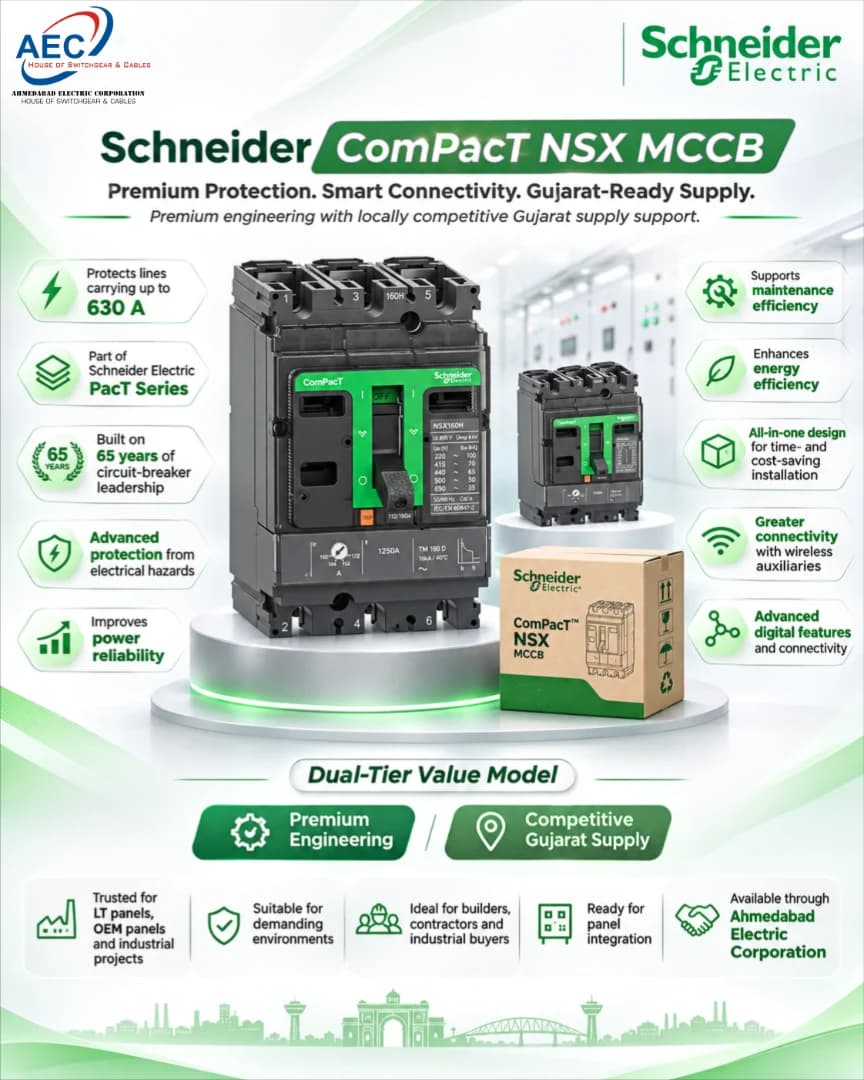
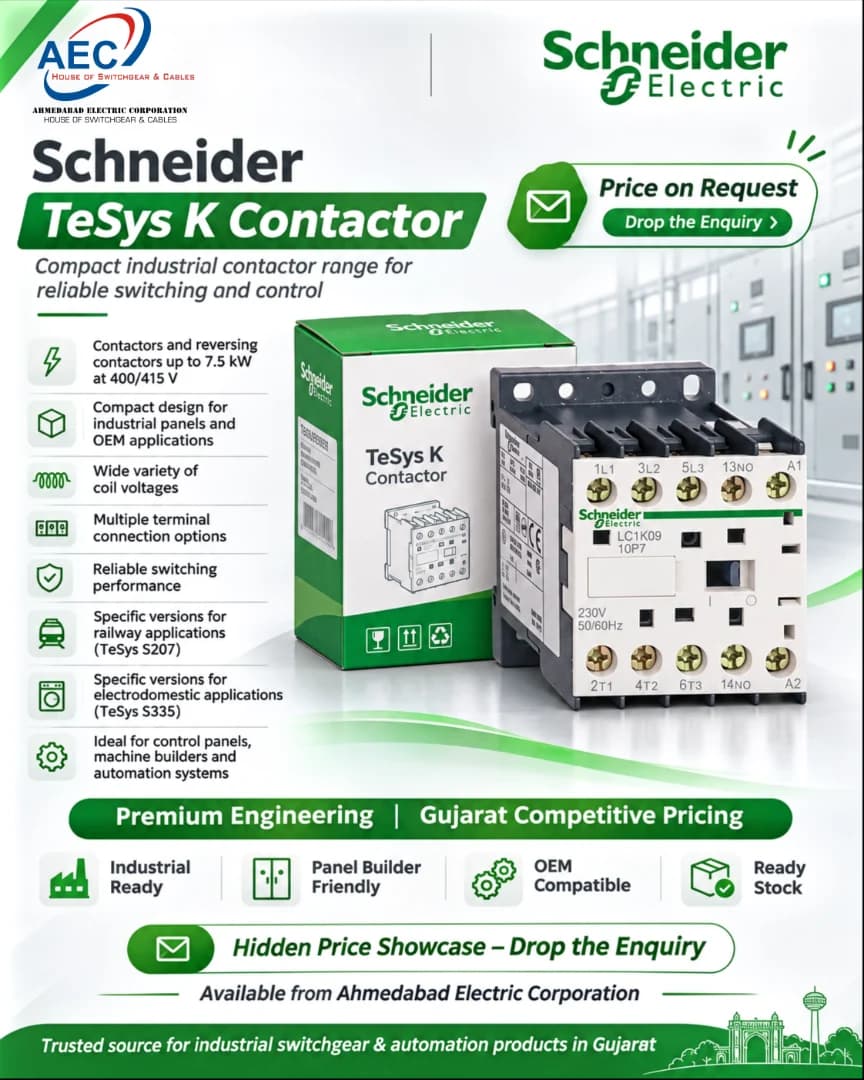
Schneider TeSys contactor coil price Vapi GIDC
18 Nov 2026

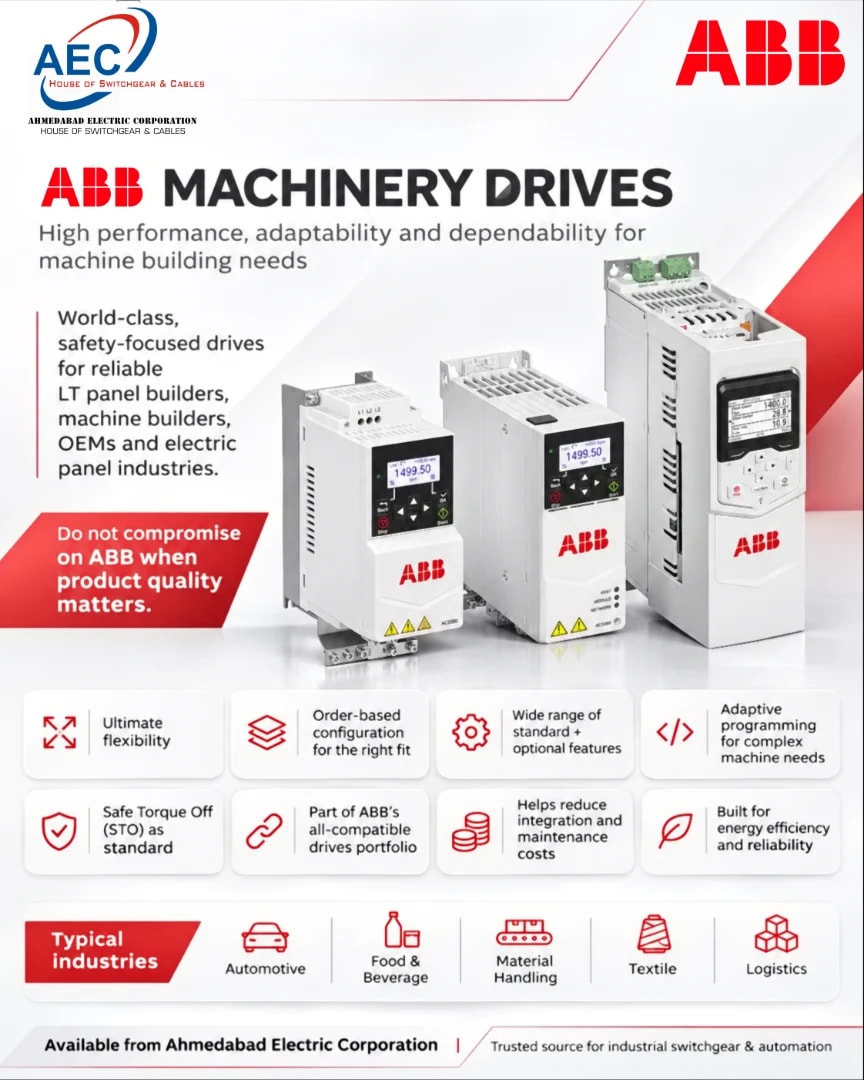
How to Choose an ABB Drive for a Cooling-Tower Fan?
Choosing an ABB variable frequency drive for a cooling-tower fan starts with the motor, cooling requirement and installation environment. A correctly selected VFD adjusts fan speed as demand changes, helping maintain water temperature while reducing unnecessary full-speed operation.
For panel builders, OEMs and maintenance teams searching for an ABB cooling-tower VFD supplier in Gujarat, Ahmedabad Electrical Corporation supports genuine ABB product sourcing through its supply network, including AIM Innovations, identified as the ABB distributor. The practical priority is straightforward: match the application, confirm the complete reference and arrange dependable delivery.
Understand the cooling-tower application first
Cooling-tower fans generally behave as variable-torque loads. Reducing speed can substantially reduce fan power when process conditions allow.
Under ideal fan-affinity conditions, operating at 80% speed requires approximately 51% of full-speed shaft power. Actual electricity savings depend on motor and drive efficiency, weather, cooling demand and operating hours. This calculation is an illustration, not a guaranteed saving.
Before requesting an ABB drive quotation, collect:
Motor nameplate power, full-load current, voltage, frequency and rated speed.
Motor type: induction, permanent magnet or another supported technology.
Fan arrangement, gearbox details and permitted operating-speed range.
Required leaving-water temperature and temperature-sensor signal.
Panel temperature, installation altitude and exposure to moisture or chemicals.
Motor-cable length, control requirements and existing protection arrangement.
Which ABB drive family should you consider?
ABB offers several low-voltage AC drive families. Selecting the correct category helps avoid paying for unnecessary functions or overlooking essential controls.
ACH580 HVAC drives: A strong starting point for cooling-tower applications involving temperature regulation and building-management integration. ABB publishes dedicated cooling-tower control guidance for this family.
ACS580 general-purpose drives: Suitable for consideration in industrial fan applications alongside pumps, compressors and other plant equipment. Assess available control functions and communication options against the project specification.
ACS180 and ACS380 machinery drives: Relevant to machinery and OEM control packages. For a packaged cooling system, confirm that the selected model provides the required current capacity, process control and interfaces.
ACS880 industrial drives: Consider for demanding industrial installations requiring more advanced control, integration or application engineering.
A cooling-tower fan does not automatically require a machinery drive simply because it is part of a machine. Select the family around the control task and operating conditions.
Size the drive by current and site conditions
Motor kilowatts provide an initial reference, but final selection must consider the motor’s rated current and the drive’s usable output current after derating.
Match the drive’s supply-voltage class to the actual electrical supply.
Check continuous output current against the motor requirement.
Apply model-specific temperature, altitude and switching-frequency derating.
Assess acceleration time and overload demand for the fan’s inertia.
Allow for planned operating conditions rather than adding an arbitrary oversized rating.
For example, two motors with the same kilowatt rating may have different nameplate currents. A drive selected only from a “15 kW VFD price” search may therefore need further checking before purchase.
Specify the controls that matter
A useful cooling-tower VFD specification includes more than start, stop and speed adjustment.
Temperature PID control: Adjust fan speed using the correct water-temperature feedback and setpoint.
Minimum speed: Follow the tower, motor and gearbox manufacturers’ limits, including lubrication requirements.
Critical-speed avoidance: Identify mechanical resonance during commissioning and configure permitted skip-frequency bands.
Windmilling restart: Assess how the drive will start a fan already rotating because of airflow.
Acceleration and deceleration: Use ramps appropriate to fan inertia and the mechanical system.
Communication: Confirm the exact PLC or BMS protocol and any required option module.
Fault response: Define sensor-failure behaviour, alarms and restart permissions for the process.
These details help maintenance teams avoid repeated trips, unstable temperature control and unnecessary commissioning delays.
Protect the drive and complete the panel correctly
Cooling towers expose nearby equipment to humidity, water droplets and sometimes corrosive contaminants. An enclosure’s IP rating alone does not establish suitability for every outdoor or chemical environment.
Locate the drive appropriately and verify enclosure ventilation, condensation control, ambient temperature and corrosion protection.
Specify upstream fuses or circuit breakers according to ABB’s instructions. Check earthing, EMC requirements, motor insulation and cable-length limits; additional output filtering may be required. Do not install power-factor correction capacitors on the drive output.
Where a bypass is required, use an engineered, interlocked arrangement that prevents mains voltage reaching the drive output. Installation and commissioning should follow the exact ABB hardware manual and tower manufacturer’s requirements.
ABB drives, contactors and switchgear for complete requirements
AEC supports procurement of ABB drives and complementary low-voltage products for industrial and general electrical distribution:
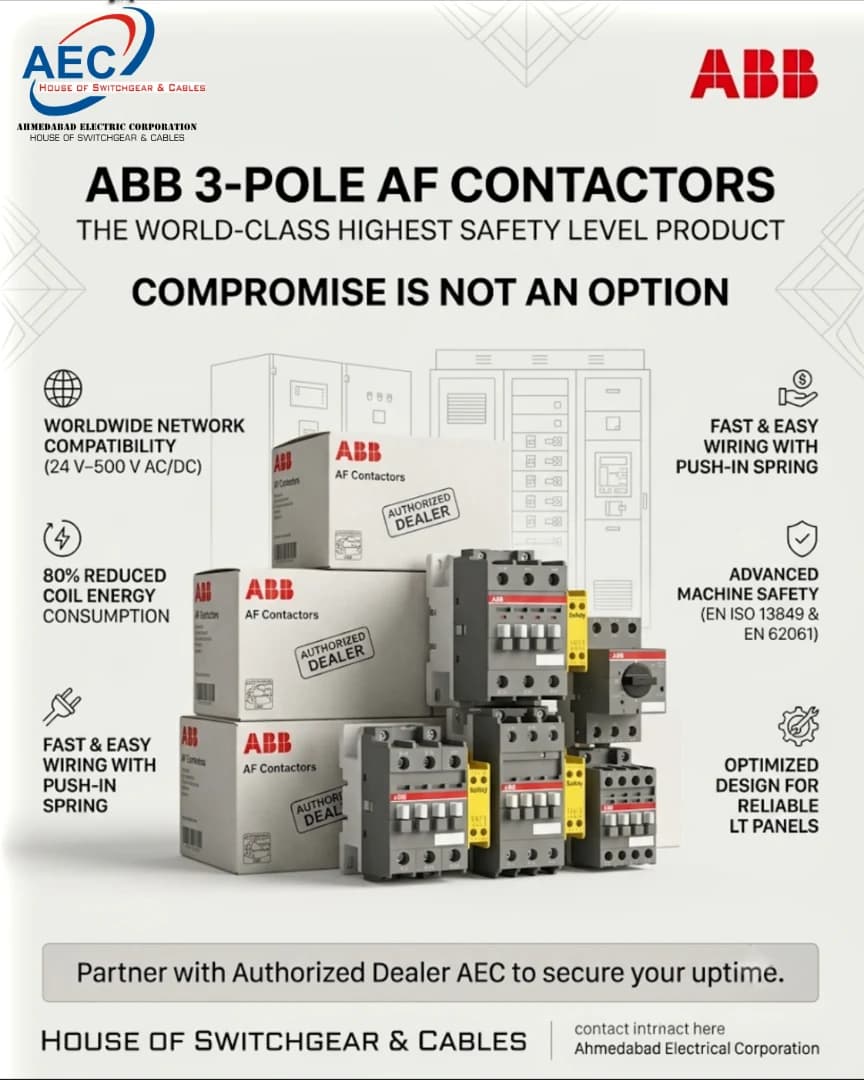
ABB AF contactors, auxiliary contacts and overload relays.
Motor-protection devices and suitable control accessories.
MCCBs, ACBs, MCBs and switch-disconnectors.
Panel components for new installations, maintenance and replacement requirements.
Ready-stock options and fast dispatch are available against confirmed references. Checking the complete bill of materials together helps prevent missing accessories from delaying panel completion.
Delivery across Gujarat cities and industrial clusters
Our Gujarat delivery coverage includes major GIDC estates and nearby industrial areas:
Ahmedabad: Vatva, Naroda, Odhav, Kathwada, Sanand, Changodar, Bavla and Dholka.
Gandhinagar and North Gujarat: Kalol, Chhatral, Mehsana, Kadi, Gozaria, Visnagar, Himmatnagar and Palanpur.
Vadodara: Makarpura, Nandesari, Savli, Waghodia and Por–Ramangamdi.
Central Gujarat: Halol, Godhra, Anand, Vithal Udyognagar and Nadiad.
Bharuch: Ankleshwar, Panoli, Jhagadia, Dahej and Jambusar.
Surat: Sachin, Pandesara, Ichhapore, Hazira, Palsana and Kadodara.
South Gujarat: Vapi, Sarigam, Umargam, Pardi, Valsad, Navsari and Bilimora.
Rajkot: Aji, Bhaktinagar, Metoda, Shapar–Veraval, Gondal and Jetpur.
Saurashtra: Morbi, Wankaner, Jamnagar–Dared, Bhavnagar–Chitra, Sihor, Surendranagar and Wadhwan.
Kutch and coastal areas: Gandhidham, Anjar, Bhuj, Mundra, Bhachau, Junagadh, Porbandar and Veraval.
Delivery targets are 4–5 days within Gujarat and 5–6 days to major Indian metros, including Mumbai, Delhi NCR, Bengaluru, Chennai, Hyderabad and Kolkata, subject to confirmed stock, order processing and transport availability. Pan-India enquiries are welcome.
For an accurate ABB cooling-tower drive price, send AEC the motor nameplate photograph, application details, quantity and delivery PIN code. Request the complete drive reference, compatible protection, genuine-product documentation and confirmed delivery schedule together—so your purchase is ready for the actual panel requirement.
Get our official brochure for more information
Contact us :-
Mr. Ravikant Gupta :- +91 9974283830 & sales@aiminnovations.in