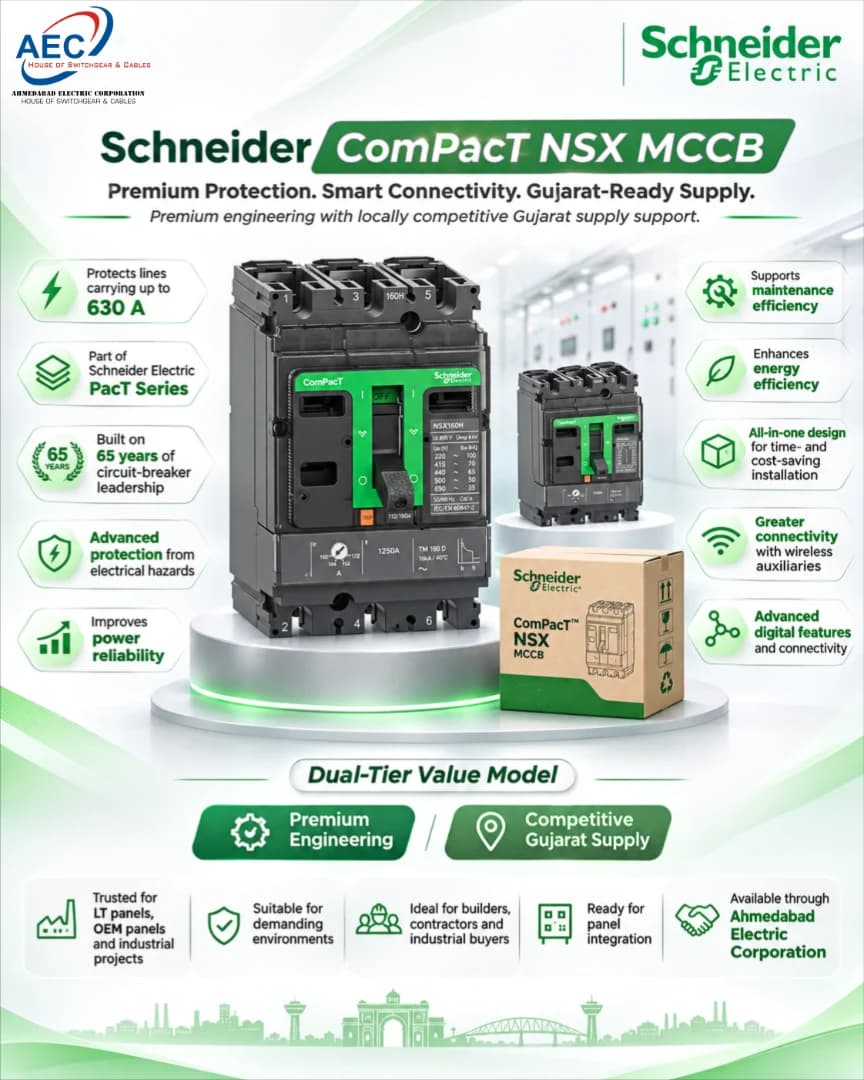
Which Schneider ComPacT NSX accessories match my breaker reference?
17 Nov 2026

How to Choose a Lauritz Knudsen ACB Frame Rating
Choosing a Lauritz Knudsen ACB frame rating starts with your electrical system: maximum demand, operating voltage, available fault current and installation conditions. Selecting only by transformer capacity or the existing breaker’s appearance can overlook important protection requirements.
For panel builders, OEMs and maintenance teams, understanding frame size, rated current and protection settings helps produce an accurate ACB quotation and a dependable installation.
Ahmedabad Electrical Corporation supports Lauritz Knudsen switchgear procurement across Gujarat and India, including enquiries commonly described as “L&T ACB replacement” or “L&T air circuit breaker selection.”
These terms describe different characteristics:
Frame size: The breaker’s construction size, associated with a manufacturer-defined range of current and fault ratings.
Rated current: The current capability of the selected breaker configuration under specified conditions.
Long-time pickup, Ir: The adjustable overload-protection threshold, within the selected release’s permitted range.
A larger frame does not automatically permit higher protection settings. Cables, busbars, terminals and the complete panel must support the intended current.
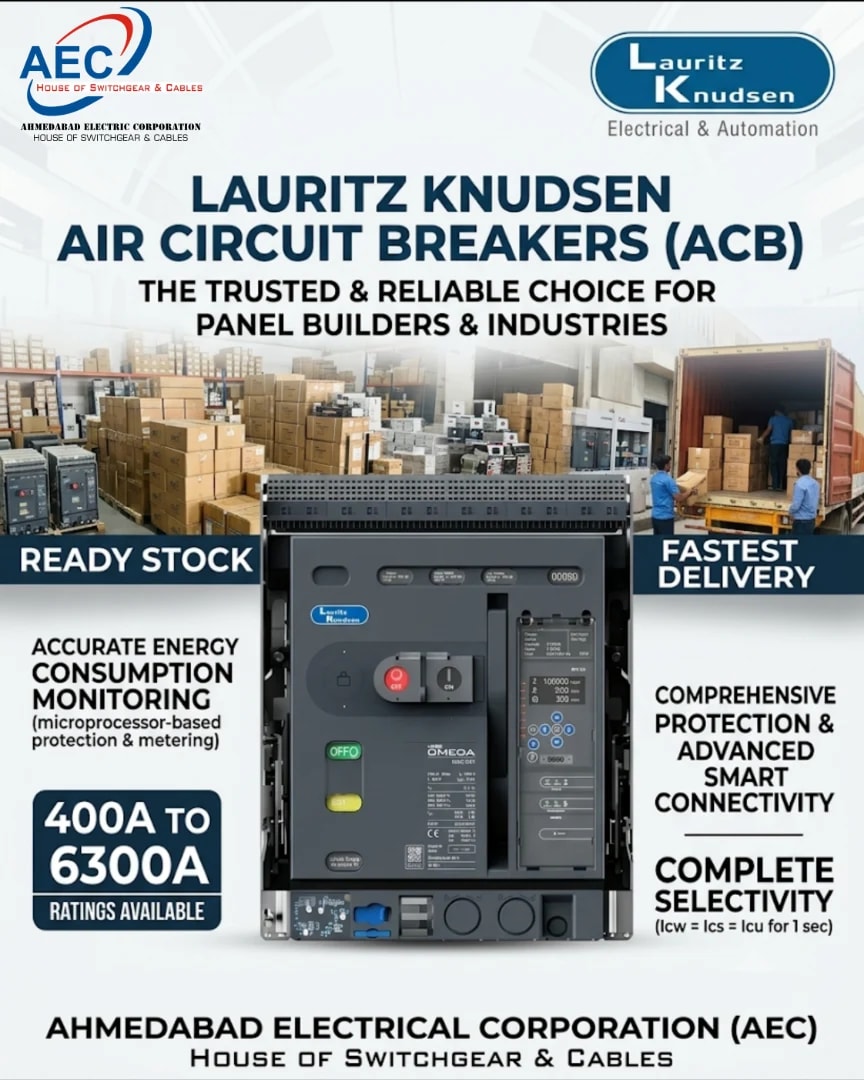
Lauritz Knudsen’s U-Power OMEGA range covers 400 A to 6300 A across three frame sizes. C-Power is another available ACB family. Use the relevant catalogue because frame arrangements and configurations differ between ranges.
1. Calculate the Required Load Current
Begin with maximum demand, load diversity and realistic expansion requirements.
For a balanced three-phase supply:
Current in amperes = kVA × 1000 ÷ (√3 × line voltage)
For example, a 1000 kVA transformer at 415 V has a full-load secondary current of approximately 1391 A. This makes a 1600 A breaker configuration a candidate for assessment, not an automatic final selection.
Check actual demand, enclosure conditions, conductor capacity and protection coordination before approving it. Avoid adding arbitrary spare capacity that could weaken overload protection.
2. Account for Temperature and Installation Conditions
Catalogue current ratings apply under specified conditions. Inside a crowded LT panel, the temperature surrounding the breaker may exceed the electrical-room temperature.
Review:
Ambient temperature inside the enclosure.
Ventilation and permitted temperature rise.
Manufacturer derating requirements.
Busbar dimensions, orientation and termination arrangement.
Altitude, dust, humidity and corrosive exposure.
Space for installation, inspection and maintenance.
A higher frame may be appropriate where thermal or connection requirements demand it. The decision should follow manufacturer data and the panel’s verified design.
3. Check Fault Ratings Separately
An ACB’s ampere rating does not establish its short-circuit capability. Lauritz Knudsen advertises breaking capacities up to 100 kA at 415 V, depending on the selected configuration.
Three ratings deserve attention:
Icu: Rated ultimate short-circuit breaking capacity.
Ics: Rated service short-circuit breaking capacity.
Icw: Rated short-time withstand current for a specified duration.
Compare these with the calculated fault level and required protection delays. Check the actual operating voltage: a rating quoted at 415 V should not be assumed valid at 690 V.
High Icw supports time-delayed coordination, but complete selectivity still requires checking upstream and downstream protection characteristics.
4. Select the Protection Release and Accessories
Specify the functions your system needs:
Long-time overload protection.
Short-time and instantaneous short-circuit protection.
Earth-fault protection where required.
Neutral protection appropriate to the load.
Metering, communication and remote monitoring options.
Compatible shunt release, undervoltage release and closing-coil voltages.
Confirm which features are included in the selected release and which require accessories. Final settings should follow the protection study and commissioning checks.
5. Confirm the Mechanical Configuration
Choose three-pole or four-pole construction according to the earthing and neutral-switching design. Compare fixed and draw-out versions against maintenance requirements.
For replacements, verify the cradle, interlocks, panel cut-out, terminal positions and busbar connections. Matching the current rating alone does not establish interchangeability.
Delivery support covers major industrial locations and smaller surrounding clusters:
Ahmedabad: Vatva, Naroda, Odhav, Kathwada, Sanand, Changodar, Bavla and Dholka.
North Gujarat: Gandhinagar, Kalol, Chhatral, Mehsana, Kadi, Gozaria and Himmatnagar.
Vadodara and central Gujarat: Makarpura, Nandesari, Savli, Waghodia, Halol, Godhra, Anand, Vithal Udyognagar and Nadiad.
Bharuch: Ankleshwar, Panoli, Jhagadia, Dahej and Jambusar.
Surat: Hazira, Ichhapore, Sachin, Pandesara, Palsana and Kadodara.
South Gujarat: Navsari, Bilimora, Valsad, Vapi, Sarigam, Pardi and Umargam.
Saurashtra: Rajkot, Aji, Bhaktinagar, Metoda, Shapar–Veraval, Gondal, Morbi, Wankaner, Jamnagar–Dared, Bhavnagar–Chitra and Sihor.
Kutch and other locations: Gandhidham, Anjar, Bhuj, Mundra, Surendranagar, Junagadh, Porbandar and Dholera SIR.
Request an Accurate ACB Quotation
Send your single-line diagram, required current, fault level, pole configuration, release functions and delivery postcode to Ahmedabad Electrical Corporation.
Genuine Lauritz Knudsen ACBs, MCCBs, contactors and other low-voltage switchgear are available for enquiry, with ready stock confirmed by catalogue reference.
Expected delivery is 4–5 days within Gujarat and 5–6 days to major Indian metros, subject to availability and transport conditions. Pan-India supply includes Mumbai, Pune, Delhi NCR, Bengaluru, Chennai, Hyderabad and Kolkata. Confirm product identification, invoice details and supply-channel documentation before dispatch.
Get our brochure for more information.
Contact us:-
Mr. Pratik Baid :- +91 95371 65041 & reliableelectrical2612@gmail.com